
Transcript
Announcer:
Welcome to CE on ReachMD. This activity is provided by Medtelligence and is part of our MinuteCE curriculum.
Prior to beginning the activity, please be sure to review the faculty and commercial support disclosure statements as well as the learning objectives.
Dr. Rossignol:
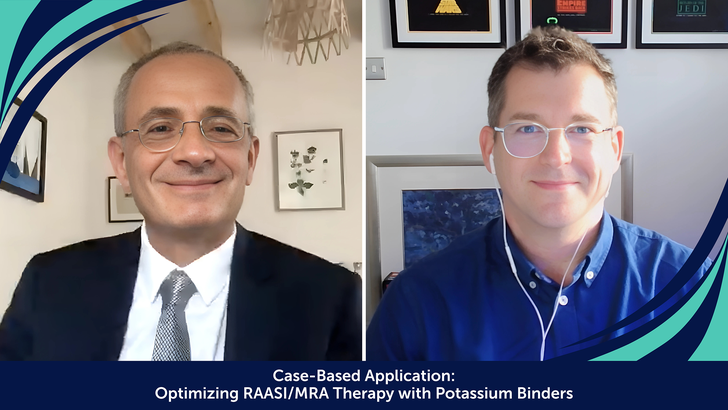
This is CME on ReachMD, and I'm Dr. Patrick Rossignol. Here with me today is Dr. James Burton. Hello, Jim. Jim, pleased to have you with us today.
Dr. Burton:
I wanted to talk a little bit about someone that I saw recently who was admitted through our emergency department, someone that we were managing between the heart failure team and the renal team, so we were managing in our cardio-renal MDT.
Someone with heart failure, reduced ejection fraction, man in his 60s. So he had CKD with a GFR of around 35. Not that much albuminuria actually, which we often see in people with heart failure, but significantly reduced ejection fraction, so around 30%. And he was on those four pillars of heart failure management. So he was on Entresto. He was on a beta blocker. He was on an SGLT2 inhibitor, and he was on spironolactone. And he presented to the ED with hyperkalemia, so with a potassium just above 6, and he ended up on our ward.
And in the ED, his spironolactone had been stopped, and he came to us with increased symptoms having stopped his spironolactone, and his potassium had come back down into the normal range because his spironolactone had been stopped. But he was getting increased symptoms of his heart failure.
And there was a conversation with the ward teams about what we should be doing with his MRA—with his spironolactone—in the context of his hyperkalemia. And I guess you've probably seen this as well, that we see people where it's a balance of their goal-directed medical therapy for their heart failure and hyperkalemia, and then you reduce their RAASi therapy, whether that is their spironolactone or another part of their therapy, and the potassium might normalize, but then they're left without their pillars of heart failure management, and they start to develop symptoms.
And so what we did in this sense is we used a novel potassium binder, got that normokalemia with the patient optimized on their dose of spironolactone, and made sure that they were discharged on their dose of goal-directed medical therapy for those four key pillars.
And we've seen evidence from studies recently where we know that using potassium binders is going to be able to facilitate goal-directed medical therapy at the same time as maintaining normokalemia.
And we've talked a little bit about some worries around edema-related events. And we saw from REALIZE-K that for those individuals who might have, for example, higher BNPs, more concerns about fluid retention, that we might exercise some caution with SZC, particularly because it exchanges sodium for potassium. But nevertheless, maintaining goal-directed medical therapy on a novel potassium binder enables us to keep normokalemia and make sure that people are discharged on the therapy that we know are going to reduce their poor outcomes in the future.
So I guess, Patrick, you've probably seen that—people coming in, they've had their therapies stopped, that they go out without their goal-directed medical therapy, and then they end up with complications coming back in again.
Dr. Rossignol:
So thank you very much, Jim. This was really insightful, and I fully agree with you that these patients are very common in our practice. And as a matter of fact, it is clearly demonstrated that initiating life-saving drugs shortly after arterialdecompensation is key to improve outcomes in this setting. Keeping in mind that this patient was recently hyperkalemic, not resuming life-saving drugs will be associated with a lack of chance, and RAASi enablement in this setting certainly helps you getting this patient back to GDMTs, and this may potentially improve long-term outcomes. But nevertheless, you succeeded in getting this patient back to GDMT. Congrats.
So, well, this has been a great discussion, but our time is up. Thanks for listening.
Announcer:
You have been listening to CE on ReachMD. This activity is provided by Medtelligence and is part of our MinuteCE curriculum.
To receive your free CE credit, or to download this activity, go to ReachMD.com/CME. Thank you for listening.


